

How to Keep Coffee Beans Fresh Longer: A 2026 Guide
Table of Contents
- How to Keep Coffee Beans Fresh Longer: The Core Rules
- How Long Do Coffee Beans Stay Fresh?
- The Best Container for Storing Coffee Beans
- How to Store Coffee Beans After Opening
- Should You Freeze Coffee Beans?
- Match Your Storage Method to How Fast You Drink Coffee
- How to Tell If Coffee Beans Have Gone Stale
- Frequently Asked Questions
Last Updated: October 21, 2026
How to Keep Coffee Beans Fresh Longer: The Core Rules
Learning how to keep coffee beans fresh longer comes down to four enemies: oxygen, light, heat, and moisture.
Coffee beans begin losing aroma and flavor within days of roasting. The volatile compounds that make a cup taste bright and sweet fade fast when exposed to air.
Here is what matters most:
- Limit oxygen. Air is the biggest threat to flavor.
- Block light. Store beans in an opaque container, not a clear jar.
- Avoid heat. Keep beans away from the stove, oven, and sunny windowsills.
- Cut moisture. Steam and humidity flatten the flavor fast.
The Specialty Coffee Association's guidance on coffee freshness notes that freshness depends on storage conditions as much as roast date.
How Long Do Coffee Beans Stay Fresh?
Whole coffee beans stay fresh for about two to four weeks after the roast date when stored well. Ground coffee goes stale far faster, often within a week. After opening, most beans hold peak flavor for roughly one to two weeks.
That window shrinks with poor storage. A bag left open on the counter can taste flat in days. A sealed container in a cool, dark cupboard stretches the good window considerably.
Freshness by Roast Date and Roast Type
Roast date matters more than most people realize. Always check the roast date, not the best-by date. Beans roasted a week ago will taste better than beans roasted months ago, no matter how you store them.
Roast type shifts the timeline too:
- Light roasts tend to peak a little later and can stay lively slightly longer.
- Dark roasts are often best early and fade a touch faster because the roast oils sit closer to the surface.
- Ground coffee loses aroma within days, so buy whole beans and grind at home.
A common mistake is buying a big bag of pre-ground coffee to save time. It is convenient, but flavor drops off quickly once the bean is broken open.
The Best Container for Storing Coffee Beans
The best container for storing coffee beans is an opaque, airtight canister with a tight seal. It blocks the two biggest threats, light and oxygen, in one move.
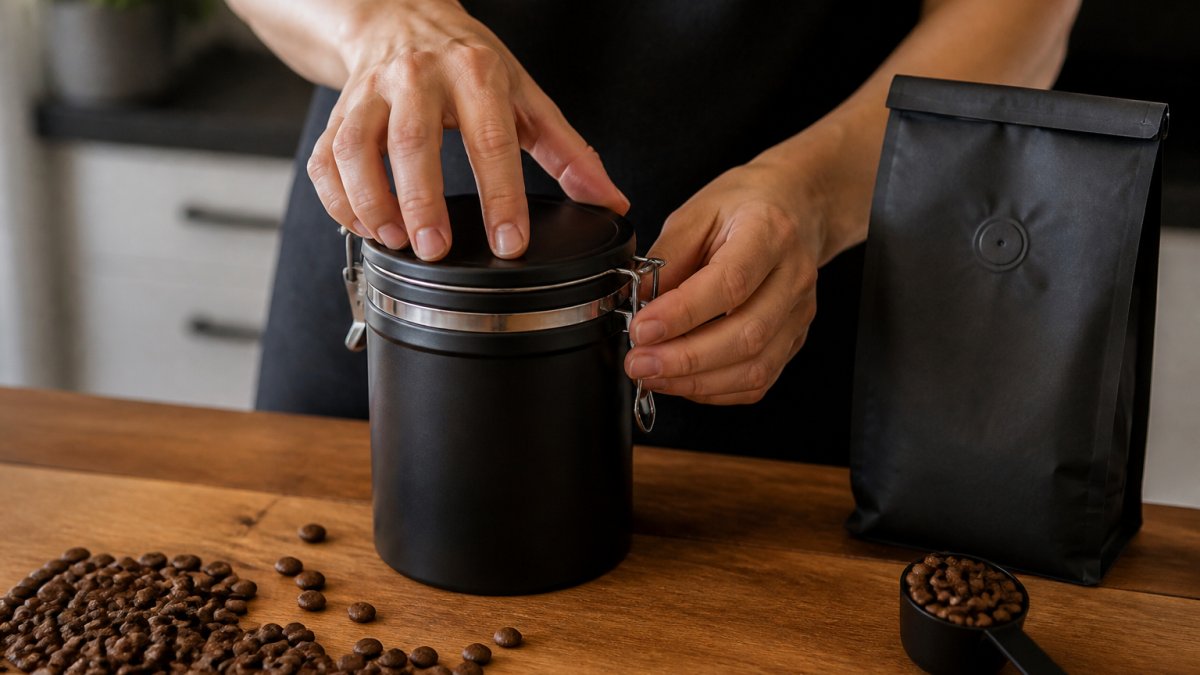
But "airtight and opaque" is the floor, not the ceiling. The right container depends on how much coffee you keep on hand and how often you open it.
Container trade-offs at a glance
- Opaque ceramic or stainless steel canisters. Best all-around choice for daily use. They block light completely and hold a tight seal. Downside: you cannot see how much is left, and some ceramic lids seal better than others, so check for a silicone gasket.
- Tinted glass canisters. Better than clear glass because they cut some light, but most tinted glass still lets some light through over weeks. Fine for a bag you will finish in a week or two; less ideal for longer storage.
- Clear glass jars. The worst common choice for anything beyond a few days. Light accelerates staling, and a clear jar on an open shelf exposes beans to daylight all day. If you love the look, keep the jar in a dark cupboard.
- Vacuum containers. These pump air out and can extend freshness, but the pumps add cost and complexity, and the seals need maintenance. Worth it if you buy large bags and drink slowly; overkill for a weekly bag.
Match container size to your pace
A container that is too large is a quiet freshness killer. Every time you open a half-empty canister, you exchange the air inside for fresh oxygen.
A common pattern among home brewers: keep a small counter canister for the week's beans and leave the rest sealed in the original bag or frozen. That way the daily-use container stays small and the reserve stays protected.
What to look for when buying
- Opaque material such as ceramic, tinted glass, or stainless steel
- Airtight lid with a silicone or rubber seal
- A size that matches your weekly use, so you are not storing a huge bag half-full of air
- A one-way valve if the container is designed for fresh-roasted beans
Original Packaging vs. Airtight Canisters
The original one-way valve bag is a solid choice, and many roasters design it well. The valve lets carbon dioxide escape while keeping oxygen out.
But the bag has limits. It is often thin, it does not always reseal tightly, and it lets in light if it is not stored in a dark place.
Our advice: keep beans in the original bag until you open it, then move them into an airtight, opaque canister. You get the best of both.
How to Store Coffee Beans After Opening
Once you open a bag, move the beans into an airtight, opaque container right away. Then store that container in a cool, dark, dry place, away from the stove and direct sunlight. This is the routine that protects flavor day to day.
Here is the simple workflow we recommend:
- Open the bag and pour beans into your airtight canister.
- Seal the lid firmly and press out excess air.
- Store the canister in a cool, dark cupboard, not the fridge.
- Keep it away from heat sources and sunny windowsills.
- Grind only what you need, just before brewing.
- Reseal the canister within a minute of scooping.
Avoid the refrigerator for daily storage. Every time you open the door, moisture and temperature swings hit the beans. Condensation is a quiet flavor killer.
Should You Freeze Coffee Beans?
Yes, you can freeze coffee beans, and it works well if you do it right.
Freeze beans only if you buy more than you will drink in two to three weeks. For a bag you will finish soon, a cupboard is simpler and just as good.
Most guides mention freezing but stop at "put the bag in the freezer." That is where flavor goes wrong.
Why freezing works, and where it fails
Cold temperatures slow the chemical reactions that fade aroma compounds. The problem is water. Every time beans move between cold and warm air, moisture can condense on their surface. That surface moisture dulls flavor and can encourage staleness. The fix is to freeze in small, sealed portions and thaw each one only once.
A Freezing Workflow: Portions and Thawing
The key is small portions and no re-freezing. Here is how we would do it:
- Divide into weekly portions. Use small airtight bags or jars, one per week. A portion should be roughly what you will brew in five to seven days.
- Remove as much air as possible before sealing each portion. If you use bags, press flat and squeeze out air; if you use jars, fill them close to the top to leave less headspace.
- Label with the roast date so you always know what you are drinking.
- Freeze flat so portions thaw evenly and quickly.
- Thaw one portion at a time in the sealed container at room temperature. Keep it sealed until it reaches room temperature, so condensation forms on the container, not the beans.
- Never refreeze thawed beans. Moisture builds up and flavor suffers.
Let a portion come fully to room temperature before grinding. Opening a cold container in a warm kitchen invites condensation, which is exactly what you want to avoid.
Freezing mistakes to avoid
- Freezing a whole large bag you will reopen repeatedly. Each opening exposes frozen beans to warm, moist air. Portion first.
- Thawing on the counter in an open bag. Keep it sealed until room temperature.
- Refreezing. Once thawed, treat the portion as fresh coffee and use it within the week.
- Storing near strong-smelling foods. Coffee beans can pick up odors, so keep portions in a sealed bag or jar inside a larger freezer bag.
When freezing is not worth it
If you finish a bag in under two weeks, a cupboard canister is simpler and avoids any condensation risk. Freezing earns its keep for bulk orders, subscription bags that arrive faster than you drink them, and weekend-only brewers who want each cup to taste fresh.
Match Your Storage Method to How Fast You Drink Coffee
The right storage method depends on your pace. A daily espresso drinker and a weekend-only brewer need different setups.
| How fast you drink | Best method | Why it works |
|---|---|---|
| Finish a bag in 1-2 weeks | Airtight canister in a cupboard | Simple, protects flavor, no freezing needed |
| Finish a bag in 2-4 weeks | Canister plus original valve bag | Keeps air and light out for the full window |
| Buy in bulk, drink slowly | Freeze in weekly portions | Slows aging, avoids waste |
| Weekend-only brewer | Small bags, freeze most of it | Keeps each cup fresh without stale gaps |
| Humid climate | Airtight canister with a tight seal | Blocks moisture that flattens flavor |
Climate matters too. In a humid area, a tight seal and a dry cupboard do more work.
This is where buying smaller amounts more often pays off. At ASE', we roast to order, so you can order closer to when you will actually drink it.
How to Tell If Coffee Beans Have Gone Stale
Stale coffee beans lose their aroma first, then their flavor.
Watch for these signs:
- No aroma when you open the bag or grind the beans
- Dull, flat flavor in the cup, with less sweetness
- A dry or papery aftertaste
- Beans that look oily and dull rather than rich and even
- A weak bloom when hot water hits the grounds
Fresh beans bloom, puffing up and releasing gas when hot water hits them.
If your coffee tastes off, check the roast date first.
Fresh beans are only half the battle.
At ASE', we roast to order so your beans start their journey as fresh as possible.
Get started with ASE' and give your daily ritual the fresh start it deserves.
Frequently Asked Questions
Can I still use 2-year-old coffee beans?
You can brew them, but the flavor will be flat and dull. Coffee beans lose most of their volatile compounds within weeks of roasting, so two-year-old beans are well past their peak. They are not unsafe to use, just disappointing in the cup. Check for a stale, cardboard-like smell and no aroma when you open the bag. If you only need caffeine, they will still work, but for a bold, balanced cup, start with freshly roasted beans instead.
Is it okay to store coffee beans in a Ziploc bag?
A Ziploc bag is better than nothing but far from ideal. Standard plastic bags are not fully airtight, let in light, and do not block oxygen over time. For short-term storage of a week or two, press out as much air as possible and keep the bag in a dark cupboard. For anything longer, move the beans to an opaque airtight container or keep them in the original one-way valve bag, which is designed to release carbon dioxide without letting oxygen in.
Do coffee beans need to be kept in an airtight container?
Yes, airtight storage is one of the most effective ways to keep coffee beans fresh longer. Oxygen causes oxidation, which strips aroma and flavor within days. An airtight container limits air exposure between brews. Pair it with an opaque design or a dark cupboard to block light, and keep it away from heat and moisture. If you use the original bag, make sure it has a one-way valve and reseal it tightly after each use.
Should coffee beans be stored in the refrigerator or freezer?
The freezer, not the refrigerator, is the better choice for long-term storage. Refrigerators are damp and hold strong food odors that beans absorb easily. Freezing works well if you portion beans into airtight bags, squeeze out the air, and thaw only what you need for the next few days. Avoid repeated freeze-thaw cycles, which cause condensation and speed up staleness. For beans you will finish within two weeks, a cool dark cupboard is simpler and just as effective.